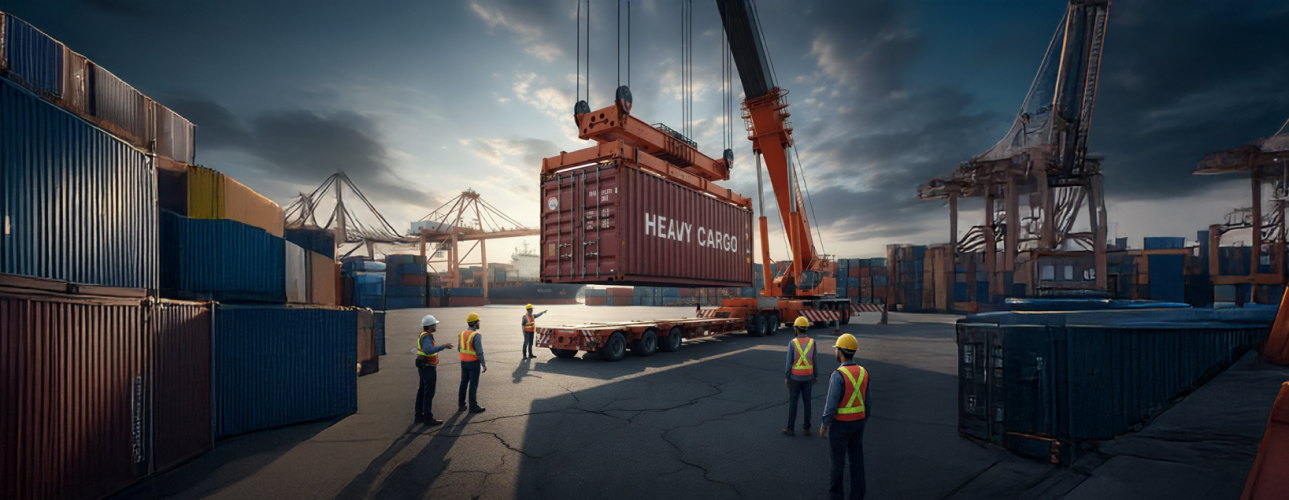


Heavy cargo doesn’t move through the U.S. like everything else.
When a fully loaded 20-foot container—granite, machinery, dense tiles, metal fabrications—reaches a U.S. port, it enters a completely different operational system than the one that brought it across the ocean.
At this point, the risks shift from equipment shortages (origin) and duty exposure (HS codes) to something importers often underestimate:
Destination delivery compliance.
And this is where delays, extra costs, and job-site disruptions tend to happen.
Before we go deeper, here are the first two parts of the series:
Part 1: The 20-Foot Container Dead End
Part 2: HS Code Fundamentals

Why This Matters Now — The Destination Blind Spot
Most freight discussions still revolve around ocean rates, vessel schedules, or port congestion.
But in the last three years:
Tri-axle availability has tightened in several U.S. regions
More states stepped up weight enforcement
Job-site constraints became more complex
Heavy cargo volumes from India increased faster than infrastructure
Trade coverage from platforms like JOC, Freightos, and CH Robinson offers excellent macro-level visibility — but destination delivery for heavy cargo remains a technical blind spot.
Importers know how to book space.
Few understand the compliance system that governs the final 20 miles.
That’s what this blueprint addresses.
Why 20’ Heavy Cargo Needs Its Own Delivery Plan
For shipments like granite, machinery, heavy tiles, and industrial freight, a 20’ isn’t a preference — it’s a necessity.
You’re managing a weight problem, not a space problem.
And once it lands in the U.S., the rules are completely different:
Axle weight limits dictate whether a standard chassis can move it.
Tri-axle allocation must be secured in advance — not post-arrival.
Route validation ensures compliant transit (some states prohibit overweight hauls on specific bridges or routes).
Live-unload coordination determines if the cargo can be delivered directly to a job site or must be devanned elsewhere.
Each of these steps is invisible to most importers — until something goes wrong.
1. Weight Distribution
A fully loaded 20’ container places more weight on fewer axles than a 40’.
Without the correct chassis, the load becomes non-compliant—even if your documentation is perfect.
2. Chassis Type
Standard chassis?
Not an option for dense cargo.
Only a tri-axle chassis can legally and safely carry many heavy 20’ shipments.
3. Route Restrictions
States differ in what they allow:
Some limit axle weight more strictly
Some restrict heavy trucks from certain bridges
Some require alternative routing
When these three factors aren’t planned early, you get the situations most importers have experienced at least once:
Driver arrives with the wrong chassis
The site can’t accommodate the truck
Delivery has to be rescheduled
Per diem or yard storage begins ticking
Nothing is “wrong”—but everything is delayed.
Why Standard Delivery Often Breaks Down
Most drayage breakdowns don’t happen at the terminal.
They happen between scheduling and dispatch — when the forwarder, broker, trucker, and consignee aren’t aligned.
Typical failure sequence:
✅ Container is cleared.
✅ Truck is booked.
✅ Payment made.
❌ No chassis available.
Everything looked confirmed — until it wasn’t.
The problem? These actions occurred in isolation instead of as a connected plan.
The 4-Step Delivery Blueprint
Step 1: Allocate the Correct Chassis
Tri-axle chassis are limited in capacity and must be requested before the vessel arrives.
They cannot be assumed as “standard.” A 40-foot tri-axle is not interchangeable with a 20-foot heavy configuration.
At Airlift, coordination for chassis begins as soon as the last port of call is confirmed.
Step 2: Validate the Route
Every state enforces its own axle-weight distribution rules.
Before dispatch, the route must be checked for bridge, interstate, and permit restrictions.
For heavy cargo, compliance isn’t just about fines — it’s about avoiding forced re-delivery or impound delays.
Step 3: Coordinate Live-Unload Timing
Heavy cargo moves differently from general freight.
Many job sites require synchronized live-unload windows or onsite cranes.
The forwarder, consignee, and driver must confirm load-off timing together to prevent detention costs.
Step 4: Exception Controls (Proactive Planning)
Exception management isn’t firefighting — it’s foresight.
Every heavy-cargo delivery faces potential variables: customs exams, chassis shortages, or consignee-side delays.
Our process builds a buffer of coordination between the consignee, broker, and trucker long before arrival.
If an exception does arise, the response is pre-mapped — not improvised.
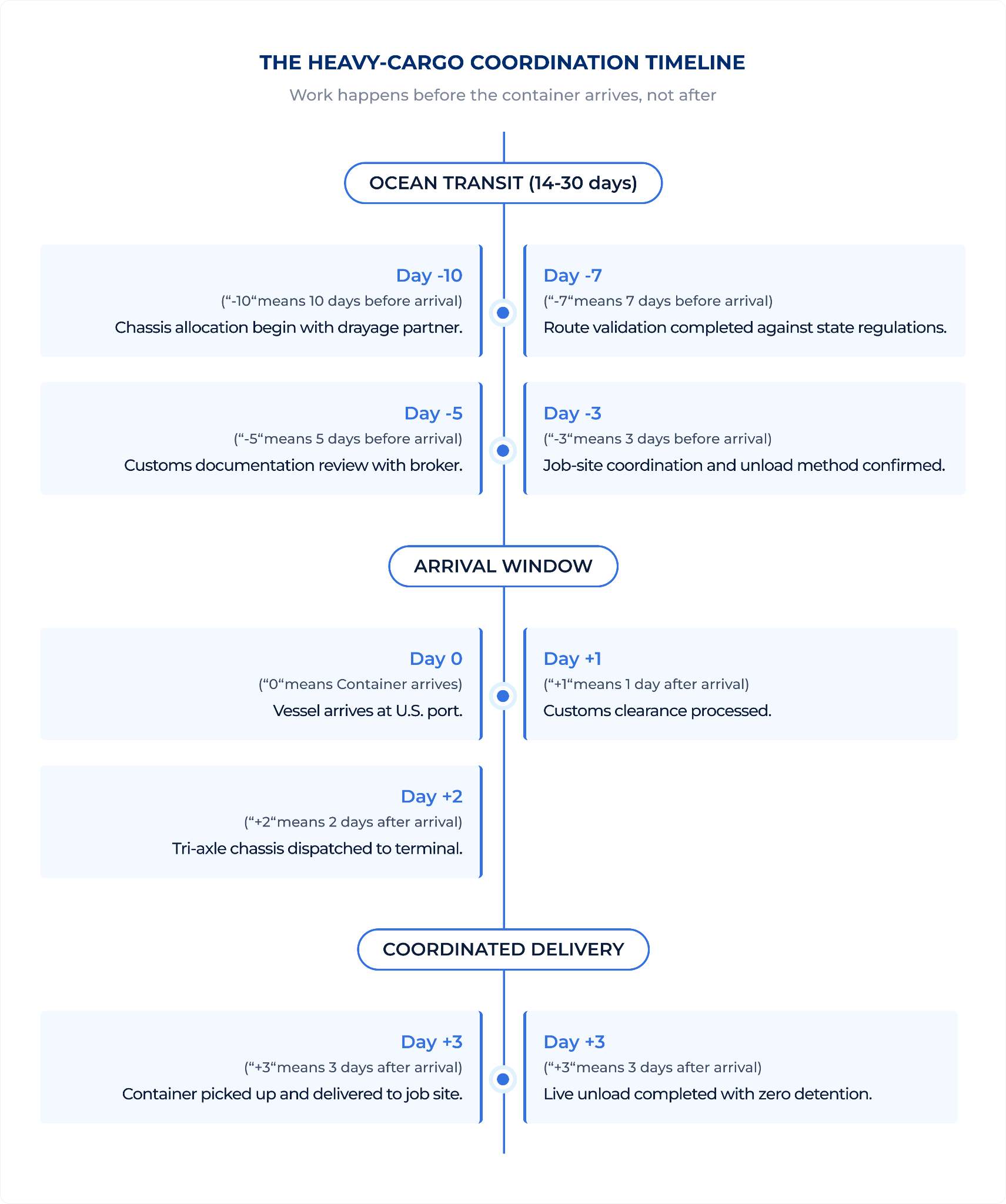
Key Insights : Pre-arrival coordination prevents 3-7 day delays and saves $2,500-$8,000 per shipment in avoidable costs.
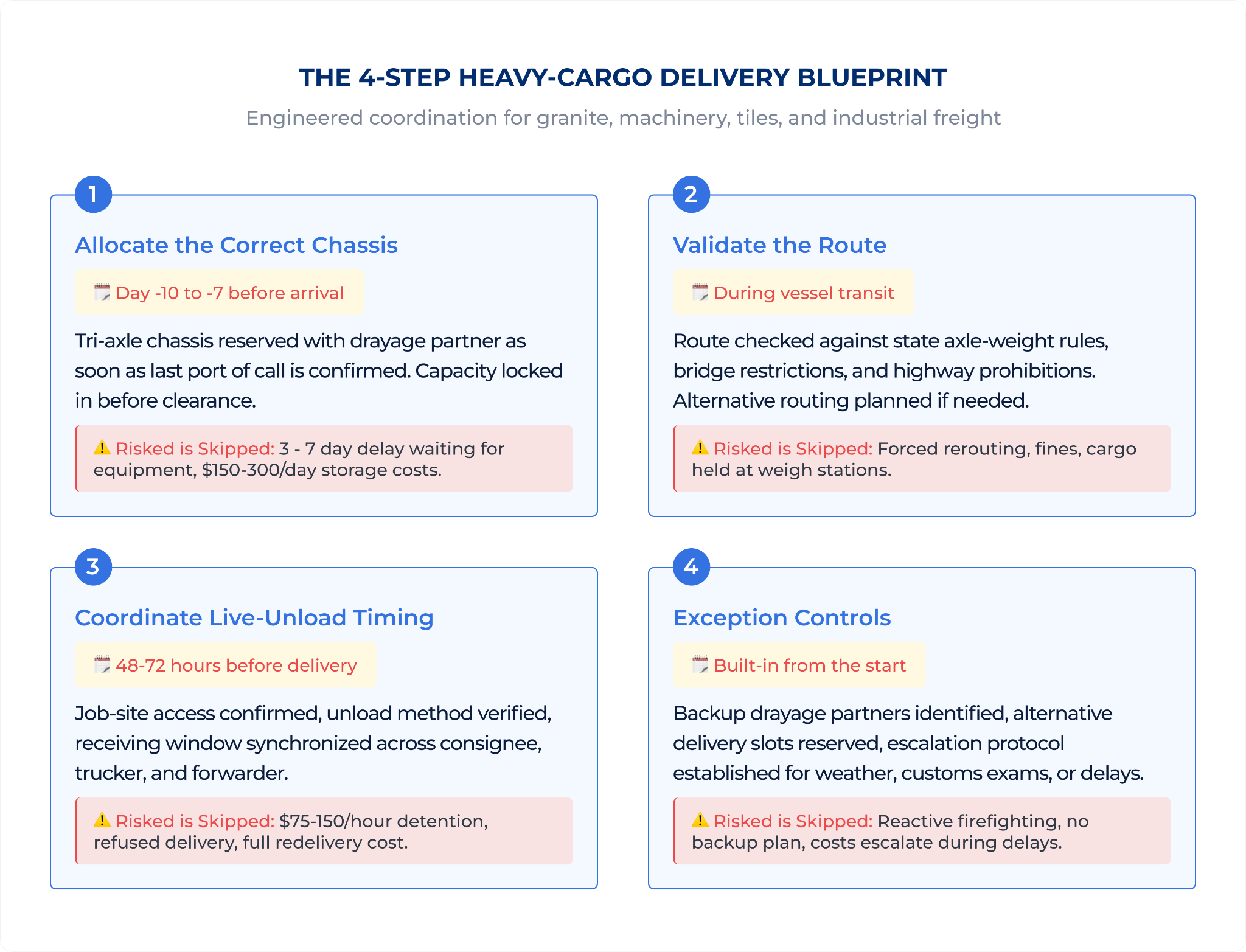
Implementation: This blueprint prevents the most common heavy-cargo delivery failures and eliminates thousands in avoidable costs per shipment.
This blueprint reflects how experienced operators plan heavy 20’ deliveries in the U.S.
It’s a process we coordinate on behalf of our customers—not via owned trucks, but through structured planning with our trusted drayage partners.
1. Pre-Arrival Chassis Allocation
During the vessel’s transit, we tentatively reserve the correct chassis type (tri-axle when required) with our trucking partner.
This early hold ensures:
capacity is locked in
you’re not waiting for equipment after clearance
the trucker can plan their route and schedule
Final confirmation happens once customs clearance is guaranteed.
2. Route & Site Validation
Before confirming delivery, we verify:
access roads
any weight-restricted routes
job-site constraints (dock height, turning radius, unload permissions)
live-unload or drop requirement
This avoids last-minute rerouting or unsuccessful delivery attempts.
3. Timing Coordination with Broker + Consignee + Trucker
A clean delivery happens when three clocks match:
clearance timing
trucker’s slot availability
consignee’s receiving window
We confirm all three before finalizing the dispatch schedule.
4. Exception Controls (The Critical Safety Net)
If delays occur—weather, congestion, chassis shortage, late clearance—we activate the fallback options available in that region:
alternative drayage partner
next-day slot hold
prioritized pickup based on appointment schedule
This minimizes per diem and storage exposure.
How Airlift Manages Destination Delivery (The Coordination Advantage)
We don’t operate trucks or perform customs clearance — and that’s intentional.
Our role is to orchestrate every moving part so delivery stays compliant, predictable, and on schedule.
Here’s how that works in practice:
Customs Alignment — We coordinate with licensed customs brokers (yours or ours) well before the vessel reaches the U.S., ensuring documentation is accurate, compliant, and ready for immediate clearance.
Pre-Delivery Planning — Once the vessel departs its last port of call, we work directly with the consignee to confirm rates, align with truckers, and finalize the delivery plan before arrival — minimizing last-minute risk.
Proactive Exception Handling — Port exams or delays may be outside anyone’s control, but we stay engaged throughout. Early visibility and active coordination mean you always have clarity, not surprises.
At Airlift, reliability isn’t about owning every link in the chain - It's about connecting them early enough that nothing breaks when timing matters most.
A Quick Checklist for Importers
If you want to verify whether your heavy-cargo delivery is fully planned, here’s a simple self-check:
Has the correct chassis (tri-axle) been allocated before arrival?
Has the job-site’s access and unload method been checked?
Has the route been validated for weight restrictions?
Has delivery timing been aligned between trucker, broker, and consignee?
Is there a fallback plan if clearance or dispatch timing changes?
If any of these are missing, the delivery is relying on luck rather than planning.
Read the Full Engineered Freight Trilogy
This guide is Part 3 of a three-part series exploring the control points that matter most in heavy-cargo logistics:
Part 1: The 20-Foot Container Dead End (Origin Equipment)
Part 2: HS Code Fundamentals (Financial Planning)
Part 3: Heavy-Cargo Delivery Blueprint (Destination Planning)
You’re reading this now.
Together, these three parts form the backbone of Engineered Freight—a way of managing shipments by planning the points of highest risk, not reacting to them.
Helpful Resource for Importers
If you found this guide useful, this resource pairs well with Part 3:
The HS Code Strategy Cheat SheetA 1-page breakdown of how to evaluate classification decisions with your customs broker.
Download your Cheatsheet
Get a quote for your shipment
Have a shipment to move? Send the origin, the destination, the cargo and the container or weight; we reply with the rate, the routing and the services included.