


In a market designed around 40’ containers, heavy-cargo importers don’t need luck — they need logistics engineered for 20-foot availability.
When Equipment Scarcity Becomes a Business Risk
If you move granite, stone slabs, tiles, industrial machinery, steel fabrications, or other dense commodities, you already know one thing:
Your shipment lives or dies on 20-foot container availability.
A typical real-world example:
Importers in Jaipur need a 20’ for stone.
Forwarder A checks one location:
“Mundra doesn’t have any. Please wait.”
Forwarder B checks the broader network:
“Mundra is tight, but Dadri has supply. We can position a unit in three days.”
Same shipment. Same region.
Different logistics design.
For heavy cargo, that difference isn’t convenience—it’s whether your project stays on schedule.
Why 20-Foot Containers Aren’t Optional for Heavy Cargo
You don’t choose a 20’ because you prefer it.
Regulations and physics choose it for you.
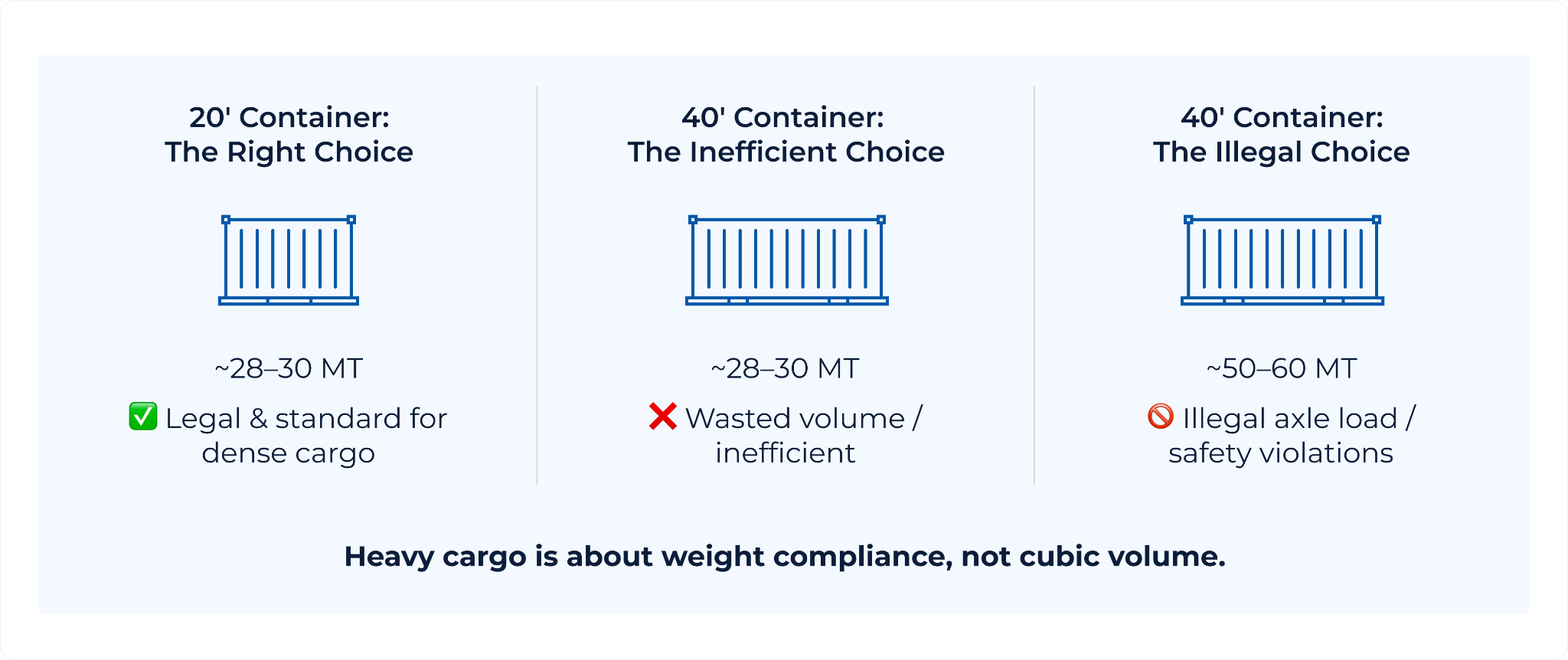
Heavy cargo is a weight problem, not a space problem.
So when someone says:
“Just use a 40-footer.”
They’re not speaking from heavy-cargo experience.
The Hidden Truth: The 20’ Shortage Starts at the Port
Most importers see the shortage inland (ICD level).
But the shortage starts at origin ports (Mundra, Nhava Sheva, Chennai, etc.).
Why carriers allocate fewer 20s
40’ units deliver better slot economics
Utilization pressure = fewer idle 20s held
Container repositioning cycles prioritize 40s
Schedule adjustments / blank sailings slow 20’ return flow
This isn’t chaos — it’s rational equipment planning by carriers.
And in India, these global decisions are magnified by:
Seasonal export surges (stone, machinery, metals)
Inland freight demand spikes
Rail rake priority cycles
Terminal-level equipment balancing
So by the time 20’ shortages appear inland, the roots are already formed upstream at ports and vessel cycles.
Two Forwarding Models: One Protects Your Timeline
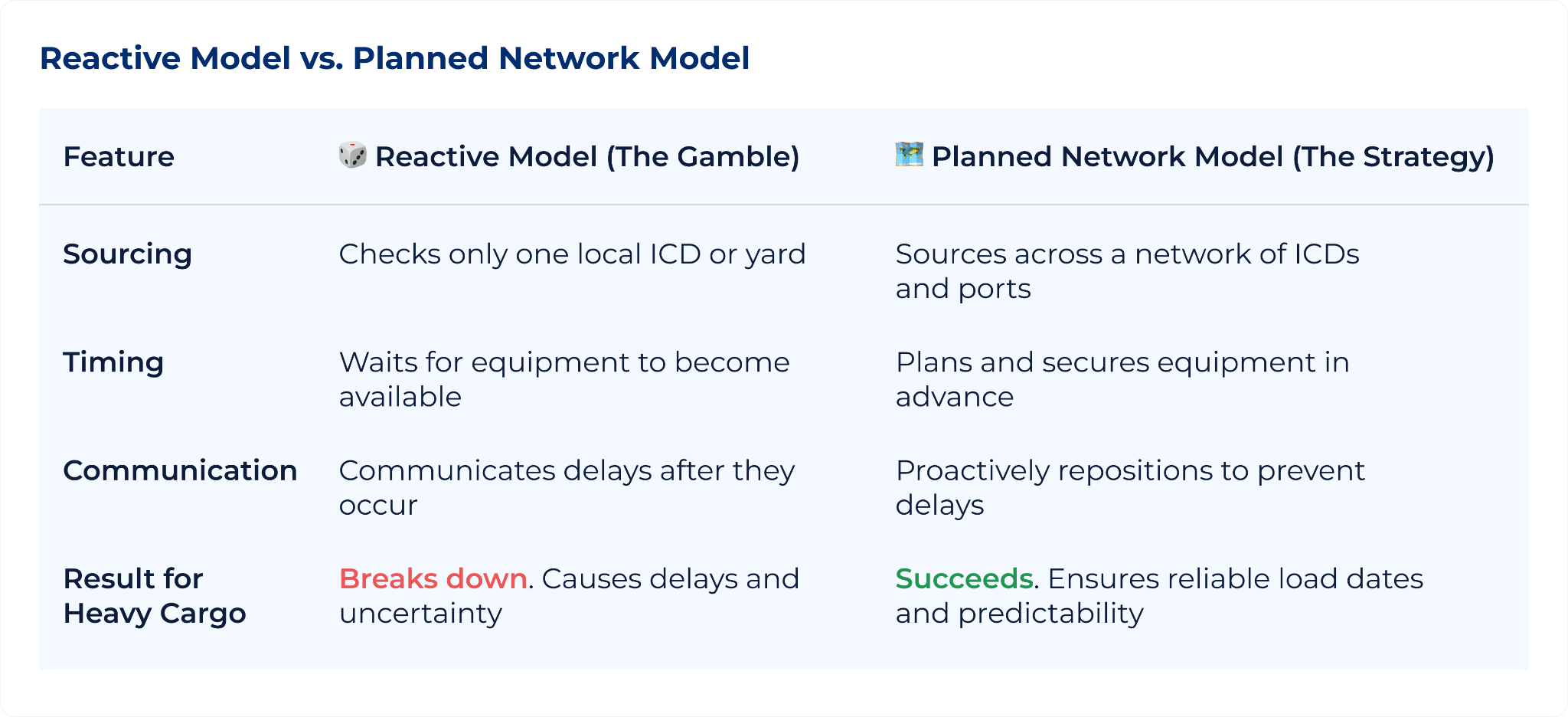
How Airlift Approaches 20’ Availability
We don't claim to magically eliminate equipment constraints.
No forwarder can.
But we plan around them using structured options that protect timelines when the market tightens.
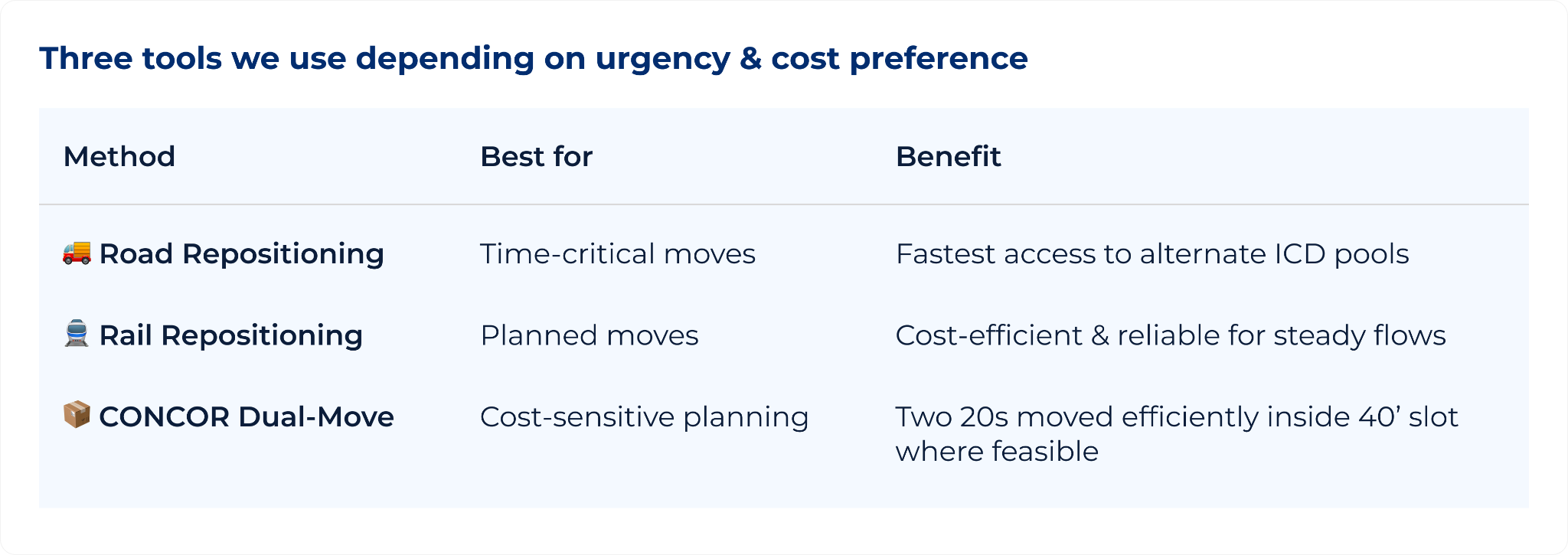
Which path we use depends on:
Your shipment urgency
Lane & origin patterns
Market cycle at that time
This is not improvisation — it’s structured planning.
What This Means for Heavy-Cargo Importers
When your forwarder checks only one yard:
Schedules slip
Loading plans change
Customer deliveries get pushed
The business carries the uncertainty
When your forwarder plans across locations & modes:
Equipment access improves
Load dates stay reliable
Planning becomes calmer & predictable
You focus on operations—not equipment availability
Reliability is not luck.
It’s preparedness.
Questions to Ask Any Forwarder Handling Your Heavy Cargo
Which ICDs and ports do you source 20’ containers from?
What is your backup plan if the primary ICD has no equipment?
Do you use rail, road, and dual-move repositioning options when required?
How early do you plan equipment for heavy-cargo lanes?
How do you communicate risk when allocations tighten?
Clear answers mean true planning.
Vague ones mean you carry the risk.
For Industry Readers: Why This Problem Exists
(Advanced insight section — optional reading)
The 20’ imbalance ties back to:
Slot economics favoring 40’ units on Asia–US lanes
Carrier capital efficiency focus post-COVID cycle
Equipment turn discipline
Inland–port evacuation dynamics
Seasonal heavy-cargo cycles in India
India’s ICD system is world-class — but in heavy-cargo peaks, ICDs feel port allocation decisions made weeks earlier.
Planning at the vessel + port + ICD + transport level is how you stay ahead of it.
Airlift’s Position
We do not claim to be the only team doing this.
We do not claim perfect availability in every market cycle.
We do commit to:
Planning ahead for heavy-cargo flows
Offering alternate sourcing paths
Communicating clearly when markets tighten
Protecting your timelines with structured options
That is how we operate.
That is what we stand behind.
If Heavy Freight Is Critical to Your Business
Share your typical movement details:
Origin region
Commodity & average weight
Shipment frequency
We’ll map a port-to-ICD equipment plan for your lane — with realistic scenarios and options.
Because for heavy cargo, reliability isn’t a promise.
It’s engineered.
Request a 20’ Reliability Review
Get a quote for your shipment
Have a shipment to move? Send the origin, the destination, the cargo and the container or weight; we reply with the rate, the routing and the services included.